Pests & Disease
Yellow Sticky Traps for Fungus Gnats: Do They Work?
Do yellow sticky traps for fungus gnats actually work? Here's what they catch, what they can't fix, and how to use them inside a full gnat-control routine.
Disclosure: The Plant Pages is reader-supported. Some pages include ads and affiliate links, and we may earn a commission from qualifying purchases, at no extra cost to you.
If a little cloud of tiny black flies rises off your soil every time you water, sticky traps are probably the first thing you reached for, and they do help. But it’s worth understanding what they actually do before you count on them to fix everything. Quick answer: yellow sticky traps for fungus gnats work by using a bright yellow color the gnats are drawn to, plus a glue coating that holds them once they land, which catches and monitors the flying adults and slowly shrinks the breeding population. What they do not do is kill the larvae living in your soil, so traps alone never fully end an infestation. The real fix is traps plus soil treatment, and below I’ll walk through exactly how to combine them.
What a fungus gnat infestation actually is
To know why traps help but don’t finish the job, it helps to picture the gnat’s life cycle. The adults you see flying are the obvious, annoying part, but they are also the short-lived part. The damage and the persistence both come from the larvae.
Fungus gnats lay their eggs in the top layer of moist potting soil. The eggs hatch into tiny, translucent larvae that live in that damp top inch or two, feeding on fungi, algae, decaying organic matter, and sometimes the fine root hairs of your plants. After a week or two they pupate and emerge as new flying adults, and the cycle starts over. Because all of this happens fast and overlaps, a pot can hold eggs, larvae, pupae, and adults all at once.
That layered life cycle is the key to the whole control strategy. Anything that only targets the adults in the air leaves the next several waves untouched in the soil. So a trap is genuinely useful, but it is one piece of the picture, not the whole thing.
How yellow sticky traps work
Sticky traps are about as simple as pest control gets, and that simplicity is part of why they are popular. There is no spray, no smell, and nothing you apply to the plant itself.
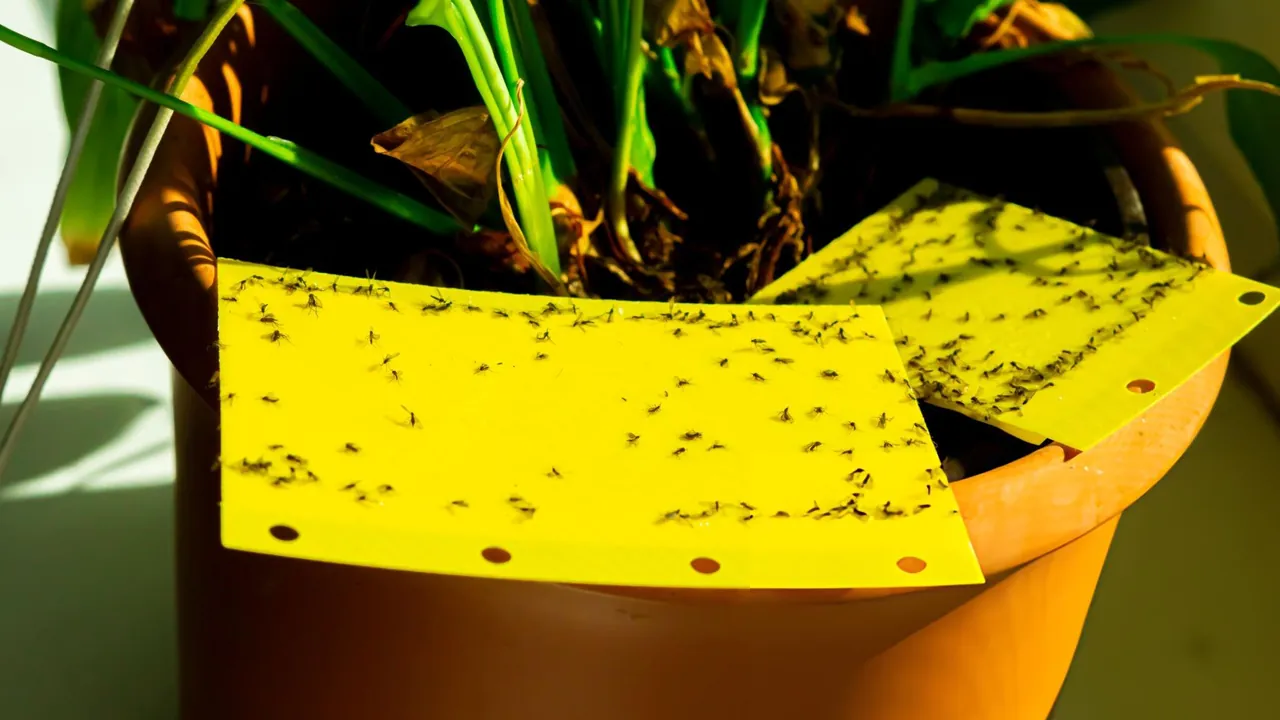
Two things make them effective. The first is color. Fungus gnats, like many small flying insects, are drawn toward a specific bright yellow in the color spectrum, and they will fly toward a yellow card the way they might drift toward a sunny window. The second is the glue. The card is coated on both faces with a clear, non-drying adhesive. When a gnat lands on the surface, it sticks fast and cannot escape, and over time the card fills with caught adults.
That is the entire mechanism: attract with yellow, hold with glue. There is no pesticide involved in a plain sticky trap, and nothing leaches into your soil. It is a passive device that works only on insects that physically land on it.
What traps do well: catching and monitoring adults
Here is where sticky traps earn their place. Every adult gnat stuck to a card is one that will not be laying the next batch of eggs in your soil. A female fungus gnat can lay a large number of eggs in her short life, so removing egg-laying adults from circulation does meaningfully slow the cycle. Run traps consistently and you steadily chip away at the breeding population generation after generation.
Traps are also an excellent monitoring tool, and this is a use people overlook. The number of gnats you catch is a running scoreboard for whether you are winning. A card that fills quickly tells you the population is still high; a card that stays nearly empty for a week tells you your soil treatment is working and the cycle is breaking. When you finally see almost nothing landing, that is your signal the infestation is genuinely fading rather than just hiding.
So traps are doing two real jobs at once: physically reducing the adult population, and giving you honest feedback on your progress. Both are valuable. Neither, on its own, reaches into the soil.
What traps cannot do: the larvae problem
This is the part that surprises people, so I want to be plain about it. Sticky traps do nothing to the larvae. The larvae live down in the moist soil; they do not fly, and they will never wander up onto a card. A trap can be jammed full of adults while a thriving population of larvae sits in the same pot, untouched, getting ready to emerge as the next wave of flies.
That is the whole reason traps alone never fully solve an infestation. You can catch adults all day, but as long as the soil stays damp and full of larvae, fresh gnats keep hatching to replace the ones you caught. People who rely on traps by themselves often describe the population dropping a bit, then plateauing, then frustratingly hanging on for months. The traps are doing their job; the soil is simply out-producing them.
The takeaway is not that traps are useless. It is that they are an adult-control and monitoring tool, and they have to be paired with something that addresses the larvae in the soil. That pairing is what actually clears the problem.
The other half: treating the soil
To break the cycle, you have to make the soil hostile to eggs and larvae. There are a few proven, low-fuss ways to do that, and they work best together.
Let the top inch or two dry out between waterings. This is the single most effective change, and it costs nothing. Fungus gnat eggs and young larvae need consistently moist topsoil to survive, so letting that top layer dry between waterings kills many of them and discourages females from laying there in the first place. Most people fighting gnats are simply keeping the surface too wet, too often. Water thoroughly but less frequently, and check the soil with a finger rather than watering on a fixed schedule. Bottom-watering, where the pot drinks from a tray and the surface stays drier, can help on plants that tolerate it.
Use a BTI product for the larvae. BTI is a naturally occurring soil bacterium (its full name is Bacillus thuringiensis subspecies israelensis) that is sold for home use in granular form, often labeled as mosquito bits. The granules are sprinkled on the soil or steeped in your watering can, and the BTI specifically targets fungus gnat and mosquito larvae while being considered safe for plants, pets, and people when used as directed. It is one of the most reliable larvae treatments available to houseplant owners. Follow the label, and reapply over a few weeks to catch newly hatched larvae as overlapping generations emerge.
Or try a hydrogen-peroxide soil drench. A common alternative is to water the plant with a diluted hydrogen-peroxide solution. The standard household 3% peroxide is mixed with water (a frequently cited ratio is about one part peroxide to four parts water, though this is a home remedy rather than a precise prescription, so go gentle and test on one plant first). When the solution hits the soil it fizzes and kills larvae on contact, then breaks down into water and oxygen. It treats the larvae that are present at that moment but leaves no lasting residual, so repeat drenches over a couple of weeks are usually needed.
A protective top layer of coarse, fast-drying material such as horticultural sand or fine gravel can also help by making it harder for adults to reach the soil to lay eggs and for new adults to climb out. Think of it as a finishing touch, not a standalone cure.
How to use sticky traps well
Traps are forgiving, but a few habits get noticeably more out of them.
- Get them close to the soil. Adults emerge from the soil and females try to lay there, so the action is right at the surface. Lay a few traps flat on the soil surface of affected pots, and stand a few more vertically just above the pots near the foliage. Many traps come on small stakes meant to be pushed into the soil for exactly this, or you can prop a card against the pot rim. Keeping traps near the soil catches far more gnats than hanging them across the room.
- Use enough of them. One small card for a whole shelf of plants will catch some gnats but barely dent the population. Put traps in and around every pot that is showing gnats, and concentrate them on the worst offenders.
- Replace them when they are covered. A trap that is full of gnats or coated in dust has little tacky surface left, and a card that has dried out stops catching too. Swap in a fresh one once a trap is crowded or no longer feels sticky. During a heavy infestation that might be every few days.
- Leave a couple out afterward to monitor. Once the population crashes, keep one or two traps in place. If they start filling again, you will catch the rebound early, before it becomes another full infestation.
Done this way, and combined with drying out and treating the soil, you should see a clear drop in flying adults within about one to two weeks. That timeline matters: traps as part of the full routine work fast, while traps by themselves can drag on indefinitely.
What to look for in a trap
Sticky traps are inexpensive and largely interchangeable, but a few features are worth checking. I am not going to point you at any particular brand, since the basics are what matter.
- A genuinely strong, non-drying glue. The whole device depends on the adhesive. A good trap stays tacky for weeks; a cheap one can dry out or feel weak from the start and lose gnats that land on it.
- A useful size and shape. Larger cards catch more and need replacing less often, while small stake-mounted traps are handy for tucking right into individual pots. A mix of both covers a collection well. Some come pre-cut into small squares, which is convenient for spreading across many pots.
- No added pesticide needed. A plain yellow glue trap needs nothing applied to it and nothing sprayed nearby; the color and the glue are the entire product. That simplicity is a feature, especially in homes with pets or kids, so there is no reason to seek out a trap that asks you to add anything.
Beyond that, do not overthink the purchase. The trap is the easy, cheap part of the plan. Your watering habits and soil treatment are what actually decide whether the gnats stay gone.
Setting realistic expectations
It helps to go in with the right mental model. A sticky trap is a population-reducer and a progress meter, not a kill switch. On day one it will catch a satisfying number of adults, and it is tempting to think the job is nearly done. It is not, because the soil is still hatching the next several waves.
What actually happens in a successful routine is a curve. For the first week or so you catch a lot of gnats as the existing adults get trapped and the last larvae you did not reach hatch out. Then, as your drier watering and your BTI or peroxide treatment take effect, fewer and fewer adults appear, and the traps fill more slowly. By two to four weeks the catch should taper toward nothing. If it does not, the most likely culprit is soil that is still too wet, so revisit your watering before blaming the traps.
Patience and consistency carry the day here. Overlapping generations mean you almost never knock out an infestation in a single pass, so keep the traps fresh and keep treating the soil for a few weeks past the point where things look fixed.
Putting it all together
If you want the short version of a plan that works, here it is. Get sticky traps in and around every affected pot, flat on the soil and standing near the foliage, and replace them as they fill. At the same time, let the top inch or two of soil dry between waterings, and treat the soil for larvae with a BTI product such as mosquito bits or a diluted hydrogen-peroxide drench, repeating over a few weeks. The traps handle the adults and tell you how you are doing; the soil treatment handles the larvae. Together they break the cycle that traps alone cannot.
For the complete step-by-step routine, including prevention so they do not come back, see our full guide on how to get rid of fungus gnats on houseplants. And if you are dealing with more than one pest at once, the same dry-and-monitor mindset applies to other invaders too; here is our walkthrough on how to get rid of spider mites on houseplants.
The bottom line: yellow sticky traps are a genuinely useful, cheap, mess-free tool for fungus gnats, as long as you understand their job. They catch and monitor the flying adults and steadily shrink the breeding population, but they cannot touch the larvae in the soil. Pair them with drier soil and a larvae treatment, stay consistent for a few weeks, and the cloud of little flies will fade for good.